Boost Fine Motor Skill Development Using 4 EYFS Strategies
Boost Fine Motor Skill Development Using 4 EYFS Strategies
Stanford Nursery Team
Imagine the joy as your child writes their name! Fine Motor Skill Development starts with fun, pressure-free EYFS play at Stanford Nursery.
Can you imagine the sheer joy of watching your child read their very first word or write their own name for the first time? Focus on fine motor skill development is a crucial milestone in preparing young learners for early writing and formal education. It should never feel forced or stressful; rather, it naturally begins through play and engaging hands-on activities. At Stanford nursery, we implement the British EYFS framework to help your child steadily develop their language and physical capabilities at a pace that matches their individual needs and age.
Prep Your Child: 7 (Discover How)
H2: What Are the Essential Early Literacy Development Steps from Scratch?
Building early literacy begins with listening and speaking, followed closely by targeted child physical development exercises EYFS that strengthen small fingers and improve pencil grip. From there, children build phonemic awareness (Phonics) and gradually learn to recognize letter shapes and connect them with their corresponding sounds.
Here are the step by step developmental stages in sequence:
Listening and Speaking
Listening and speaking skills serve as the foundational foundation for all future language acquisition and reading readiness. Children learn to comprehend words, express their thoughts and interact with peers long before they transition to printed letters.
These skills are nurtured through reading picture books, chatting about daily events, encouraging open questions and listening to age appropriate nursery rhymes. Such motor skills activities in preschool
expand vocabulary and enhance sentence comprehension across different contexts.
Fine Motor Skill Development
Before asking a child to write, they must first strengthen the small muscles in their hands and improve hand/eye coordination so they can control a pencil with confidence and ease.
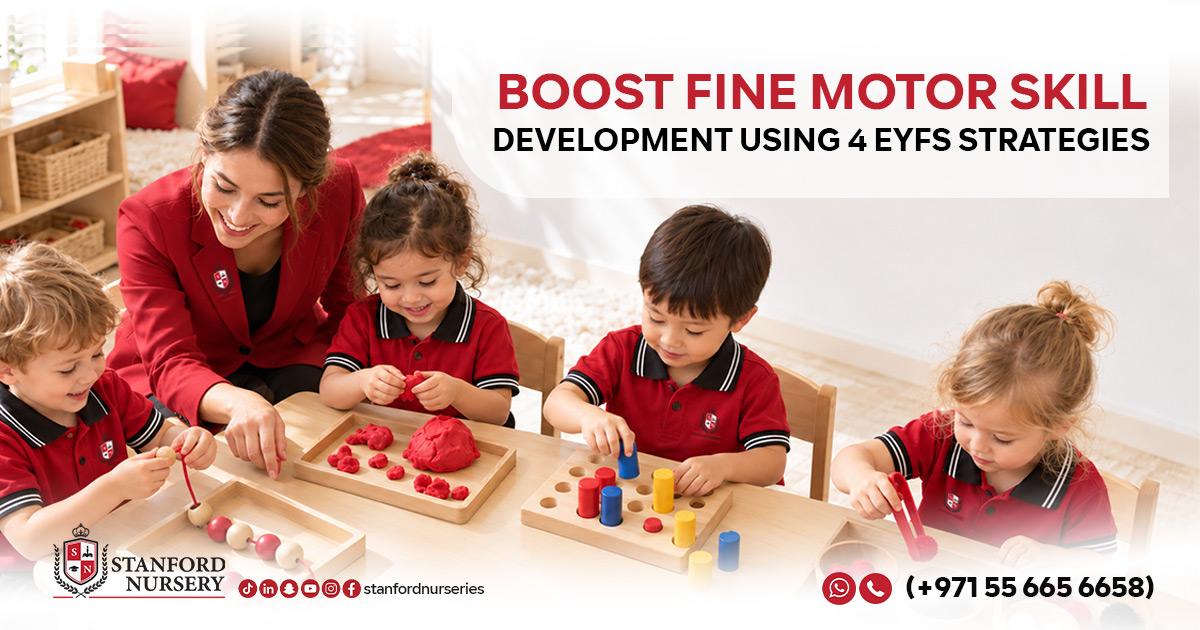
This is easily achieved using hand muscle development toys and games , such as playing with playdough, building blocks, using child-safe tweezers, drawing, coloring and tearing paper. At Stanford nursery, children are guided to trace simple lines and pathways before moving on to letter formation. These activities refine finger control and prevent hand strain, respecting each child's natural pace without any pressure to write prematurely.
Compare 4 Criteria for a (Work vs Home)
Developing Phonemic Awareness (Phonics)
Once a solid spoken foundation is established, children begin noticing and differentiating between sounds within words, identifying initial sounds or rhyming patterns.
Parents and educators can nurture this through auditory games, singing songs with repetitive sounds, breaking simple words into syllables and highlighting familiar daily sounds. These exercises bridge the gap between spoken sounds and written symbols, laying the groundwork for reading and spelling. It is helpful to note the distinction between general phonological awareness (focused on spoken language) and formal Phonics instruction (which links sounds directly to written letters). Phonics concepts should always be introduced gradually through playful, age-appropriate activities.
Letter Recognition and Sound Association
At this stage, children learn to visually distinguish letter shapes and pair each letter with its sound. This connection enables them to move from listening to understanding how speech is represented in print, opening the door to reading and writing.
Letters can be introduced using flashcards, storybooks, tactile play like tracing letters in sand or dough and associating each letter with familiar everyday words. Repeating these activities across different scenarios builds long-term memory and easy recognition.
H2: How Does Stanford Nursery Support Bilingual Literacy in Both English and Arabic?
At , we deliver the British EYFS curriculum with high professional standards while maintaining a deep commitment to national identity and the Arabic language.
Understanding the difference between fine and gross motor skills allows our educators to design balanced classroom physical activities. This bilingual setting builds a strong linguistic foundation that prevents confusion and accelerates learning in both languages, ensuring holistic academic and personal growth without compromising pride in their native tongue.
: Why Parents Choose Stanford
H2: When Do Children Start Learning Phonics, and How Do We Make It Fun?
Learning letter sounds falls under the "Literacy" umbrella, which is one of the Specific Areas of the British EYFS framework.
We introduce literacy through guided play and the interactive STEAM model. This approach seamlessly incorporates practical fine motor skill development routines, such as shaping playdough, coloring and path tracing,making word building and spelling intuitive and enjoyable without resorting to rote memorization.
: A 10-Point Checklist
H2: What Are the Most Effective Ways to Teach Reading and Writing at Home?
The most effective home strategies integrate early learning into daily play and family routines.
Key methods include:
Bedtime Storytelling: Reading illustrated books helps children connect imagery with vocabulary and expands imagination.
Interactive Flashcards: Boosts visual memory and sound recognition.
Sensory Integration Activities for Toddlers : Using colored sand, buttons, or water play strengthens tactile engagement, visual focus and spatial attention.
Dedicated Art Spaces: Setting up coloring and drawing areas supports fine motor skill development and prepares little hands for proper pencil hold.
What Is ? A Parent's Complete Guide
H2: Why is Stanford Nursery Your Ideal Choice for Building Your Child's Academic Future?
Sustainable early development requires a well-rounded educational environment that blends guided play with academic preparation through purposeful fine motor skill development .
This is precisely what we offer at stanford nursery across our 8 branches in Abu Dhabi (including Al Mushrif and Mohammed Bin Zayed City), as well as our branches in Al Ain and Khorfakkan.
Give your child a joyful, enriching learning journey, Book a Tour today to explore our classrooms, or contact us directly via WhatsApp to begin your child's journey toward a bright academic future.
Guiding your child toward reading and writing begins with small, meaningful steps that combine fine motor skill development , language acquisition, phonemic awareness and letter recognition through active exploration and play. At stanford nursery, our British EYFS curriculum provides an inspiring learning environment that nurtures confidence and school readiness.
Book a visit to stanford nursery today and give your child a fun, solid foundation for life.